TRANSPERS News: Phillips Honored: Women of Precision Medicine 2026, new publication on hidden costs and inequalities shaping cancer care, and more
Letter from the Director

Dear Colleagues,
Spring is nearly here, and with it comes a fresh new chapter for TRANSPERS. This first newsletter of the year brings research worth paying attention to — our team's latest work on the cost impacts reshaping cancer care, alongside a close examination of genetic testing models that reveals both their promise for patients and their troubling gaps for underserved populations. We're also proud to spotlight our team's upcoming speaking engagements, including an Emerging Scholar talk that signals the exciting direction of this work.
There's much to share and even more to look forward to — let's get started.
Best,
Kathryn
News
Kathryn Phillips Honored: Women of Precision Medicine 2026

Kathryn Phillips was honored as one of the Women of Precision Medicine 2026, an initiative by DeciBio recognizing women making meaningful impact across the precision medicine landscape. Peers across the industry nominated this year's cohort of 20 women, who represent leadership spanning oncology, diagnostics, therapeutics, women's health, clinical care, and data-driven innovation. The group reflects the depth and diversity of expertise — across academia, startups, industry, clinical care, and policy — required to advance precision medicine today. These women are driving real-world progress, turning innovation into impact, and shaping the future of precision medicine for patients everywhere.
Publications

New Study shows Immunotherapy's Real-World Impact: Who Benefits — and Who Gets Left Behind
TRANSPERS researchers Danea Horn, Mireille Jacobson, and Kathryn Phillips had a study published in the Journal of Managed Care & Specialty Pharmacy showing that 75% of colorectal cancer drugs were approved through expedited FDA pathways that prioritize speed over extensive testing. One-third of current CRC drugs still lack confirmed long-term benefits from required follow-up studies, with some waiting up to seven years for confirmation. The study also highlights the growing complexity of precision medicine, with 100% of drugs approved since 2018 requiring diagnostic biomarker testing, which complicates both clinical decisions and managed care coverage policies. This study serves as a foundation for Danea’s broader research program, considering how limited evidence from expedited approvals shapes decision-making in healthcare.
Study shows Drug Discount Program Is Costing Medicare Billions — And Patients Aren't Benefiting
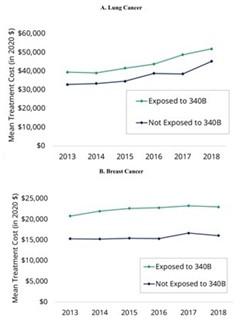
A federal program designed to help hospitals that serve low-income patients is instead costing Medicare billions of dollars a year, according to a new study published in the Health Services Research. TRANSPERS researcher Danea Horn and Kevin Schulman studied nearly 120,000 elderly cancer patients. They found that those treated at hospitals in the 340B Drug Pricing Program received far more cancer drugs than patients treated elsewhere. The extra treatment barely made a difference — patients lived only about one month longer on average. The reason is a financial loophole: hospitals buy drugs at up to 50% off but charge Medicare full price, meaning the more drugs they prescribe, the more money they make. In total, researchers estimate the program costs Medicare an extra $4.8 billion every year for lung and breast cancer patients alone — raising serious questions about who this program is really designed to help.
VA Study Reveals Which Genetic Testing Models Work — and Which Are Failing Cancer Patients

Co-authored by TRANSPER researcher Emily Mrig, a Veterans Affairs-sponsored study published in JAMA Network Open found that how hospitals deliver genetic testing to advanced prostate cancer patients dramatically affects the speed, accuracy, and fairness of care. Across nearly 2,000 veterans, the research found that embedding genetics specialists in cancer clinics produced the best outcomes. However, a nationwide specialist shortage makes that approach impractical at scale. In the meantime, researchers recommend having oncologists manage the entire testing process themselves, a model that cut wait times from nearly three months to just weeks. Most alarmingly, the study uncovered a racial disparity in which Black patients were significantly more likely to end up with incomplete tests when care was divided between an oncologist and a remote genetics counselor — raising urgent questions about who bears the highest cost when medical systems fragment.
Dissemination
TRANSPERS Researcher Emily Mrig will present at the American Society of Preventive Oncology (ASPO)

On April 14th, 2026, Emily will present "Cascading Payment Barriers Across the Precision Oncology Continuum: From Treatment to Prevention and Implications for Multi-Cancer Detection Tests" at the American Society of Preventive Oncology (ASPO) annual meeting.
TRANSPERS Director Phillips presented at the UCSF Cancer Center Symposium
On February 6th, Kathryn Phillips, Director of TRANSPERS, presented at the UCSF Cancer Center's Progress in Early Cancer Detection Symposium, addressing one of the field's most pressing questions: What Do Insurers Want for Insurance Coverage?
Upcoming talks

TRANSPERS Researcher Emily Mrig will be speaking at the Emerging Scholars Exchange Program at the University of Pennsylvania
Emily will deliver an Emerging Scholars Talk at the University of Pennsylvania on April 23rd, presenting "From Promise to Practice: How Payment, Coverage, and Institutional Dynamics Shape Access to Precision Medicine." Dr. Mrig's research examines how uneven payer coverage, inconsistent guidelines, and patient-facing costs create barriers to access to genomic testing. Her NIH-funded work on ctDNA testing in lung cancer patients uses AI and stakeholder engagement to identify which patients get tested — and why — to develop strategies to ensure equitable access to precision medicine advances. The Emerging Scholars Exchange Program is a collaborative program with peer universities developed to provide professional development opportunities for early career faculty. Conceived by the Faculty Development Committee at the University of Michigan’s Institute for Healthcare Policy & Innovation (IHPI), the Exchange Program is a collaboration between IHPI, Penn LDI, and UCSF’s Philip R. Lee Institute for Health Policy Studies.
TRANSPERS Director Phillips will present at the National Academies of Medicine Genomics and Public Health Roundtable
Kathryn will be presenting at the National Academies of Medicine Genomics and Public Health Roundtable on April 29th focusing on insurance coverage for genomic tests.